
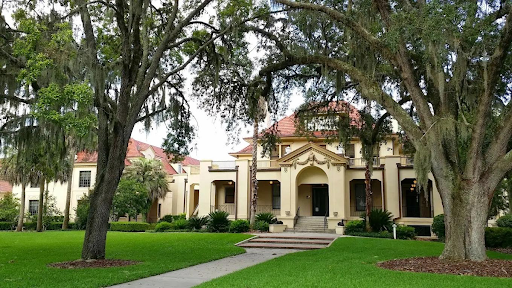
For more than two decades, anyone looking to tour and learn about Gainesville’s historic Duckpond neighborhood had the same physical walking tour. But in an effort to reach more people and make the walking tour more accessible, a group of University of Florida students developed a digital walking tour of the area.
Five students developed the website as part of the Alexander Grass Scholars Undergraduate Research Program, a Center for the Humanities and the Public Sphere initiative that immerses students in the community through locally focused humanities projects. Guided by Clarissa Carr, Ph.D., a historic preservationist who now serves as the Center’s Digital Scholarship Specialist, they provided historical context and background for 14 featured stops.
“It’s been since 2000, so longer than a lot of them have been alive, since the last walking tour of the Duckpond neighborhood had been updated. And even so, it’s in a published form where a lot of people don’t know about it,” Carr said. “They made something that could really be useful for community members and Gainesville tourists alike.”
(From left to right) Rebekkah Hudson, Ellie Riggs, Claire Busansky, Resli Ward and Guillermo Diaz utilize the Matheson Museum archives to research the history of Gainesville, the Duckpond neighborhood, and Historic Gainesville, Inc.
As a central goal of the Grass Scholars program is to engage students with the community, the project gave those not from Gainesville an opportunity to better understand the city they now call home, Carr said.
But even students from Gainesville could learn a thing or two about the city through the program. Third-year history major Resli Ward, a Gainesville native, said part of the appeal of the project was the opportunity to learn more about her hometown.
The group interacted with preservationists and other community members, but Ward said one of her most valuable interactions was with her father. After the team divided the properties among its members, she was assigned the Holy Trinity Episcopal Church. Although she attends the church, Ward said that speaking with her father, who has been a member since before she was born, revealed stories she could not have found online.
“Telling the stories of our communities is so incredibly important because a lot of those stories are not necessarily widely circulated,” Ward said. “They’re circulated within families, but maybe not out there for everybody in the general public to see. So, telling those stories is really cool and really important.”
(From left to right) Resli Ward, Ellie Riggs, Rebekkah Hudson, Guillermo Diaz and CHPS Digital Scholarship Specialist Clarissa Carr stand by their presentation of the Duckpond digital walking tour.
The project is accessible through the 2025 Grass Scholars projects page and the Matheson Museum website, but Ward wanted to establish a way for an even wider audience to discover their tour. She developed the idea of printing a QR code linking to the site on cards, which were placed around town, including at City Hall and the Thomas Center.
Fellow project member Rebekkah Hudson, a fourth-year history and linguistics major, said she was drawn to this project because she was interested in “the interaction with space and place.” And with UF providing so many STEM-related research opportunities, she was excited to see the same kind of opportunity for the humanities.
“I’m very interested in space and place, and I knew through this narrative, we could tell a story about this really historic region in Gainesville,” Hudson said. “It was something that not only involved archival research, as well as oral histories, but also could be something that community members could learn from and use as well.”
The group started by taking their own stroll through the Duckpond neighborhood, meeting with UF alumni working in preservation and gaining a broader understanding of the field. They studied reports and documents, did interviews with community members and exposed themselves to resources they might be able to use in future research, Carr said.
They familiarized themselves with the Matheson and UF’s online digital collections and even had the opportunity to work with a 360°camera that was used for taking photos for the digital tour. Hudson said they also developed their public speaking skills through the interviews and final presentation at the Matheson Museum. “We’re talking to community members who might not otherwise have a chance to share their voice, so I think that’s really cool, and honestly it’s a really one-of-a-kind program,” Hudson said of Grass Scholars. “I really am proud of what we were able to create.”